
Server Storage Performance
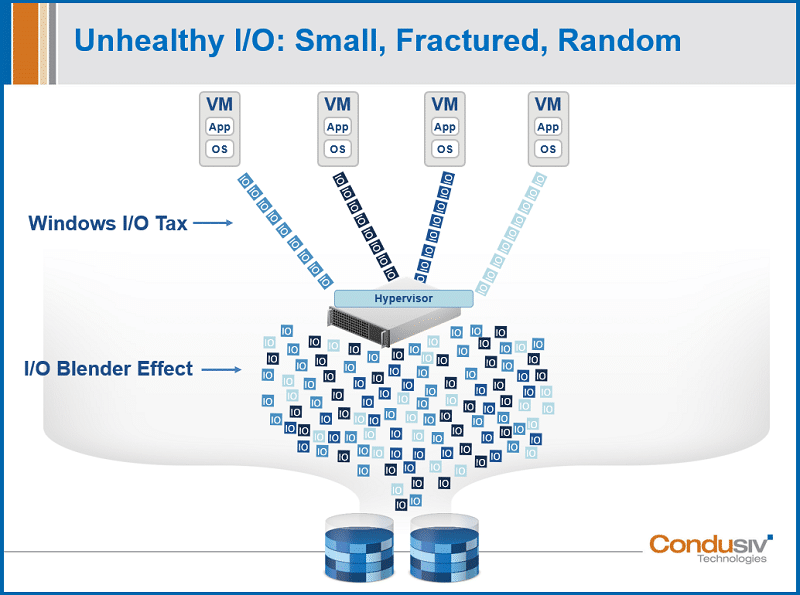
The root cause of server storage performance issues for I/O intensive applications running on virtual or physical servers can be traced back to I/O inefficiencies due to many small writes and reads that chew up system performance. It is akin to pouring molasses on even the most powerful systems since a majority of the I/O traffic is much smaller than it needs to be.
This “death by a thousand cuts” scenario inflates IOPS, robs throughput, and shortens the lifespan of HDDs and SSDs alike. Many organizations reactively attempt to mask this problem by overspending on new storage hardware for more performance.
The “I/O Blender Effect” Impact
For virtual environments, this is a problem on steroids as the I/O streams from disparate virtual machines (VMs) are mixed together and randomized via the “I/O blender effect” before sending out to storage a very random and difficult profile to process.
Because this inefficiency wastes system resources at its most basic production level, the file, and because of the sheer scale of read/write operations on even a small corporate server, I/O bottlenecks build up fast and create slows on all Windows servers.
Throwing new hardware at the problem does not solve it because Windows is still Windows no matter the underlying storage.
Addressing Root Cause of Server Storage Performance Issues
Condusiv’s server storage performance solutions address root cause performance issues at the point of origin where I/O is created by ensuring large, clean contiguous writes from Windows to eliminate the “death by a thousand cuts” scenario of many small writes and reads that chew up performance.
Condusiv’s DymaxIO® electrify performance even further with the addition of DRAM caching – using idle DRAM to serve hot reads without creating an issue of memory contention or resource starvation. Condusiv’s “Set It and Forget It” software optimizes both writes and reads and guarantees to solve your toughest application performance challenges or your money back for 90 days – no questions asked.
Customer Examples and Quotes:
CHRISTUS Health doubled its electronic health record performance and avoided a $2 million storage upgrade
Bell Mobility saw 3X faster SQL queries
Stockport College cut student enrollment processing times from 15 minutes to 5 minutes
ASL Marketing’s SQL batch job dropped from 27 hours to 12 hours
Myron Corporation cut processing times of artwork on their file servers from 5 minutes to 1 minute
Supreme Lending saw page load times on their in-house lending software drop from 5 seconds to 1 second
“Condusiv served over 50% of my reads from DRAM and eliminated over 30% of write traffic. Now everything is more responsive!” – David Bruce, Managing Partner, David Bruce & Associates
“Our throughput doubled, so we could backup in half the time!” – Curtis Jackson, Network Admin, School City of Hammond
“Our ERP with a SQL database saw an immediate 50% boost!” – Hamid Bouhassoune, Systems Engineer, Global Skincare Company
“We were amazed by the performance boost of our most I/O intensive applications!” – Victor Grandmaiter, IT Director, Fort Bend Central Appraisal District